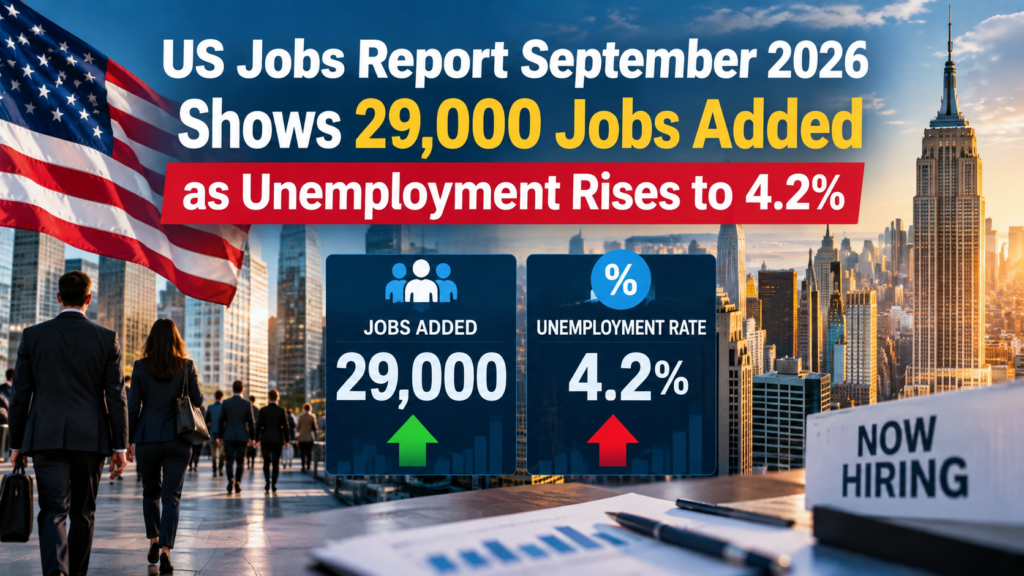
US Jobs Report September 2026 Shows 29,000 Jobs Added as Unemployment Rises to 4.2%
US Jobs Report September 2026
The US Jobs Report September 2026 shows just 29,000 jobs added and unemployment up to 4.2%. See the numbers, what they mean, and what to do next.
US Jobs Report September 2026: 29,000 Jobs Added as Unemployment Rises
Imagine a restaurant that hired three new servers every month all year. Then one month it hires one and quietly stops posting the other openings. Nobody’s panicking yet, but you notice.
That’s roughly the mood of the US Jobs Report September 2026, released Friday, October 2. The economy added just 29,000 jobs and the unemployment rate rose to 4.2%. Economists had been expecting something much stronger. Here’s what happened and what it means for you.
US Jobs Report September 2026: The Headline Numbers
The September 2026 jobs report from the Bureau of Labor Statistics (BLS) missed forecasts by a wide margin. Economists expected about 90,000 jobs and unemployment holding at 4.1%. Other surveys had forecasts in the mid-80,000s, but the miss was big either way.
| Metric | September 2026 | What was expected |
|---|---|---|
| Jobs added | 29,000 | ~84,000 to 90,000 |
| Unemployment rate | 4.2% | 4.1% |
| Average hourly earnings (monthly) | +0.1% | n/a |
| Average hourly earnings (yearly) | +3.0% | n/a |
| Revisions to prior months | About 60,000 fewer jobs | n/a |

Sources: BLS data as reported by CNN, CNBC, and NBC News.
Two details stand out. The revisions to earlier months removed about 60,000 jobs from what was previously reported. And BLS now shows a loss of 10,000 jobs in July and a gain of 133,000 in August. So the earlier numbers looked a bit better than reality.
Why Unemployment Rose to 4.2% in September 2026
A higher unemployment rate usually sounds like layoffs. This time the story is more mixed.
Bloomberg noted the rise partly reflects a growing workforce. More people started looking for work, and not everyone found a job right away. That pushes the rate up even without a wave of firings.
It’s like a bus getting more crowded because more people showed up at the stop, not because seats were removed. Still, the seats aren’t multiplying fast either.
Context helps here. The unemployment rate has stayed between 4.1% and 4.3% since March. So this is a small move inside a narrow range, not a sudden break.
US Job Growth September 2026: Where the Hiring Happened
Gains were thin and concentrated. Here’s the sector breakdown:
– Health care: Added 17,000 jobs, below its 12-month average of 33,000 per month.
– Construction: Added 11,000 jobs, with the AI data center build-out driving demand for skilled workers.
– Manufacturing: Added 9,000 jobs, extending its gains to four straight months.
– Government: Lost 17,000 jobs.
– Information: Lost 10,000 jobs.
– Professional and business services: Lost 9,000 jobs.
– Financial activities: Lost 7,000 jobs.
One more wrinkle: private employers added 46,000 jobs, so the private sector did better than the 29,000 headline suggests. Shrinking government payrolls dragged the total down.

US Labor Market September 2026: The Paycheck Problem
Jobs are only half the story. Paychecks are the other half.
Average hourly earnings rose just 0.1% from the prior month and 3% from a year earlier. That’s the sixth straight month of wages trailing inflation.
In plain terms, even if you have a job, your raise may not be keeping up with grocery and rent increases. That squeeze doesn’t show up in the unemployment rate, but people feel it.
About 4.5 million people were also working part time for economic reasons, meaning their hours were cut or they couldn’t find full-time work. This is why “4.2% unemployment” doesn’t capture how everyone is doing.
Is 29,000 Jobs Actually a Disaster?
Not necessarily. This is where the US employment data 2026 needs context.
The number of jobs needed to keep unemployment steady has dropped a lot. Some economists now put the break-even pace anywhere from zero to 55,000 jobs a month, compared with more than 100,000 when immigration was running higher from 2021 through 2024.
So 29,000 is weak but not catastrophic. Still, the economy has averaged 68,000 jobs per month so far this year, and September came in well below that.
What the Fed Might Do Next
Markets care about this report because of interest rates. Vanguard economist Adam Schickling said the data strengthens the case for the Federal Reserve to stay patient. In other words, a weak report doesn’t automatically mean quick rate cuts. The Fed also weighs inflation, and wages are still a worry on that front.
What You Can Do: A Simple Step-by-Step Plan
Whether you’re job hunting or just nervous, here’s a practical checklist.
Step 1: Check your own industry. Look at the BLS Employment Situation page and the St. Louis Fed’s FRED database. Both are free and show job trends by sector. Health care, construction, and manufacturing are hiring more than government or finance right now.
Step 2: Refresh your profile. Update LinkedIn and your resume. Set job alerts on LinkedIn, Indeed, and Glassdoor for the exact titles you want.
Step 3: Look at adjacent roles. If your field is shrinking, find related jobs. Many skills transfer, such as project management from construction to data center work.
Step 4: Build a cushion. Aim to cover a few months of expenses in a high-yield savings account. Even small, consistent deposits help.
Step 5: Know your safety net. If you lose a job, your state unemployment office handles claims. CareerOneStop.org, run by the Department of Labor, offers free training and job search help.
Step 6: Ask about your pay. If wages trail inflation, a well-prepared raise conversation using market salary data from sites like Glassdoor or Levels.fyi is reasonable.
What to Watch Next
The October report is the next major data point. Pay attention to three things:
1. Whether payroll gains rebound or stay near the 30,000s.
2. Whether the unemployment rate stays inside the 4.1% to 4.3% range.
3. Whether further revisions change the story again.
One month rarely tells the whole story. BLS numbers get revised, so treat any single report as a snapshot.

FAQs About the US Jobs Report September 2026
How many jobs were added in the US Jobs Report September 2026?
The economy added 29,000 jobs, well below economist forecasts of roughly 84,000 to 90,000.
What is the US unemployment rate for 2026 after the September report?
It rose to 4.2%, up from 4.1% the previous month.
Which sectors lost jobs in September 2026?
Government, information, professional and business services, and financial activities all saw declines.
Why did unemployment rise if hiring didn’t collapse?
Part of the increase came from more people entering the labor force and looking for work, not just from layoffs.
Are wages keeping up with inflation?
Not right now. Wage growth of 3% over the past year has trailed inflation for six straight months.
When is the next jobs report?
The BLS typically releases the employment report on the first Friday of the month, so look for the October data in early November. Check bls.gov for the exact date.
The Bottom Line
The US Jobs Report September 2026 shows a labor market that’s cooling, not collapsing. Hiring is slow, unemployment ticked up to 4.2%, and paychecks aren’t stretching as far as they used to.
If you’re employed, stay informed and keep your skills sharp. If you’re searching, lean toward sectors that are still adding jobs and use free resources like CareerOneStop and your state workforce agency.

C0-Founder and Editor
Tazeen and Arzoo are the Co-Founders and Editors of THE NEWSTER. They specialize in covering world news, technology, weather, business, and trending stories. Their mission is to deliver accurate, timely, and well-researched journalism while making complex topics clear, reliable, and easy for readers to understand.
About The Author