Woman Charging Earth Fee Says Everyone Must Pay for Sunlight
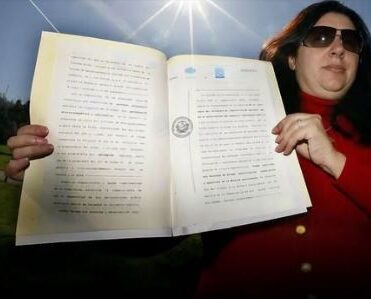
A Spanish woman claims to own the Sun and wants to charge an Earth fee for sunlight. Here’s the full story, the legal reality, and why the world took notice.
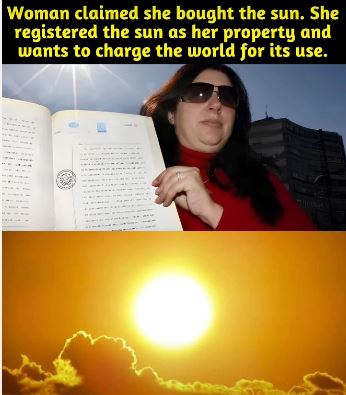
What if you woke up one morning and got a bill not for electricity, not for gas, but for sunlight? That’s exactly the scenario a Spanish woman tried to make reality when she declared herself the legal owner of the Sun and announced plans to charge every person on Earth a fee for using it.
It sounds like the plot of a quirky comedy film. But Ángeles Durán is a real person, and her solar ownership claim bizarre as it sounds generated serious global headlines and an even more serious legal conversation about who, if anyone, can own something in outer space.
This article breaks down the full story who Durán is, how she pulled off the registration, what she actually planned to do with the money, and most importantly whether any of it holds up legally. By the end, you’ll understand exactly why this story went viral, and what it quietly reveals about the gaps in international space law.
Who Is Ángeles Durán? The Woman Who “Owns” the Sun
Ángeles Durán is a resident of Salvaterra do Miño, a small town in the Galicia region of northwestern Spain. She’s not a lawyer, a space scientist, or a billionaire with a rocket company. She’s an ordinary person who read a news story, spotted what she believed was a legal gap, and decided to act on it.
Durán says she got the idea after reading about an American man who had registered his ownership of the Moon and most of the planets in the solar system all the celestial bodies that don’t actually do much for us day-to-day. Her logic was simple: if someone can claim the Moon, why not go straight for the source? The Sun, she reasoned, was the most valuable real estate in the solar system, and nobody had officially taken it yet.
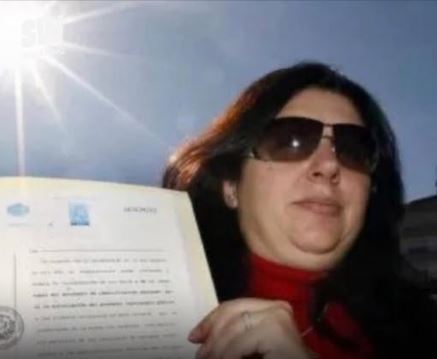
Durán formalized her claim at a local notary office, producing documents that declared her the official owner of “the Sun, a star of spectral type G2, located in the center of the solar system, at an average distance from Earth of about 149,600,000 kilometers Her explanation for why she could do this? “There was no snag, I backed my claim legally, I am not stupid, I know the law. I did it but anyone else could have done it it simply occurred to me first.”
The Earth Fee: How Much Would Sunlight Actually Cost You?
Once the solar ownership claim was in hand, Durán got to the part that really caught the world’s attention: the fee for sunlight.
She proposed charging everyone who benefited directly or indirectly from the Sun’s energy which covers practically the entire human population, as well as companies and governments. In other words, her customer base was all 8 billion of us.
Her proposed split was remarkably specific: 50% of proceeds would go to the Spanish government, 20% to the country’s pension fund, 10% to scientific research, 10% to ending world hunger, and just 10% kept for herself.
In an interview with VICE, Durán expanded on how she imagined enforcement might work. She suggested that solar panel companies would need a license from the government to operate, and that governmental agreements would be how she kept track of usage. Any companies that refused to pay would face judicial proceedings.
She even addressed edge cases. When asked about places like Barrow, Alaska which experiences months of near-total darkness in winter she confirmed that residents there would only pay for about nine months of the year. The Sun is her property, and she was apparently open to seasonal pricing.
Solar Ownership and Space Law: Does Her Claim Actually Hold Up?
The Outer Space Treaty, which has been in effect since 1967, establishes that space, the Moon, and other celestial bodies cannot be appropriated by any nation through claims of sovereignty, use, occupation, or any other means, as they are considered the common heritage of mankind.
That sounds like a clear barrier to Durán’s claim. But she had a counter-argument ready.
Durán maintained that the prohibition applies only to states, not to individual citizens, arguing that this distinction would legitimize private ownership over celestial bodies. Legal experts, however, disagree. The prevailing interpretation of international law does not recognize this kind of loophole as a valid basis for private ownership of stars or planets.
What the Notary Document Actually Does?
There’s an important distinction most viral headlines glossed over. Registering a declaration at a notary’s office does not transform that declaration into a recognized legal right especially when the claimed object is a celestial body belonging to no country and essential to all life on the planet.
In plain terms: Durán’s document is a formal record of her personal declaration. It’s not a property deed. No government, court, or international body has recognized her solar ownership claim as legally binding. No mechanism exists that could compel governments, companies, or citizens to pay for the use of sunlight under her claim.
She’s Not the First A Brief History of Celestial Property Claims
Durán’s story is unusual, but she’s part of a longer tradition of people trying to claim ownership over things in space.
A man named Dennis Hope did essentially the same thing with the Moon back in 1980. Hope has reportedly made money by selling “acres” of lunar land to buyers, generating millions of dollars though neither his claim nor Durán’s has ever been officially recognized by the United Nations.
In Durán’s case, the precedent cuts both ways. The fact that Hope’s Moon scheme attracted paying customers shows that people find these ideas entertaining enough to spend real money on. But it also shows these ventures operate as novelties, not legitimate property transactions.
Durán herself faced a legal challenge when a man from A Coruña claimed to be the owner of the universe and therefore the Sun. A Spanish court reportedly recognized Durán as the only person with an official document claiming solar ownership and closed the case. Which is less a vindication of her claim and more a sign that courts aren’t interested in adjudicating celestial real estate disputes.
Why the Sun Property Rights Story Went Viral?
Part of it is the sheer audacity. There’s something deeply funny and strangely admirable about a person from a small Spanish town deciding, on a Tuesday, that she was going to claim the Sun. The logic is internally consistent. The presentation is completely serious. And the target sunlight, the most universal thing on Earth is so absurd that it’s impossible not to pay attention.
But beneath the humor is a legitimate question that the story surfaced space law has some serious gaps. The Outer Space Treaty was written in 1967, during the Cold War, when “space commerce” meant government agencies launching satellites. It was designed to prevent nations from colonizing the Moon, not to address what happens when private individuals or companies start making claims.
As commercial space exploration has accelerated with companies planning to mine asteroids, establish lunar bases, and potentially sell space tourism Durán’s satirical-seeming land grab looks less like a joke and more like an accidental stress test of an outdated legal framework.
Years later, the case is still cited in discussions about space law and the limits of property rights a symbolic claim that found enormous public repercussion but little concrete legal support.
FAQ: Your Questions About the Sun Ownership Claim Answered
Can a person legally own the Sun or charge a fee for sunlight?
No. Under the 1967 Outer Space Treaty and prevailing international law, no individual, company, or government can legally own a celestial body. A notarized declaration of ownership is a personal document with no legal force it does not create a right to collect fees for sunlight.
Who is the woman who claims to own the Sun?
Her name is Ángeles Durán, a Spanish woman from Galicia who registered a declaration of solar ownership at a local notary in 2010. She has since maintained the claim and even attempted to sell plots of the Sun online. The story resurfaced in 2025–2026 as it continues to circulate on social media.
What did Durán plan to do with the money from her Earth fee?
She proposed a specific revenue split: half to the Spanish government, a portion to pensions, a share to scientific research, some to fighting world hunger, and a percentage kept for herself. It was a surprisingly altruistic plan for a fee nobody is legally required to pay.
Has anyone ever successfully claimed ownership of space property?
Not in any legally recognized sense. Individuals like Dennis Hope (Moon) and Ángeles Durán (Sun) have created novelty documents and sold symbolic “plots,” but no international legal body recognizes these as valid property claims.
Could space property law change in the future?
Possibly. As commercial space activity grows, pressure is building to update international frameworks. Some countries have passed domestic laws allowing companies to own resources extracted from space (like minerals), but outright ownership of celestial bodies stars, planets, moons remains legally off the table.
Conclusion: More Than a Joke, Less Than a Legal Revolution
Ángeles Durán’s claim to own the Sun and charge the Earth a fee for sunlight is, in the most literal sense, unenforceable. No court will back it, no government will honor it, and you are under no legal obligation to pay for the sunshine coming through your window.
But dismissing the story entirely misses what makes it interesting. It exposed a genuine quirk in international space law a set of rules designed for a world where only superpowers had rockets, now trying to keep pace with private companies planning Mars colonies and asteroid mines. Durán walked through a door that the law left half-open, and the world noticed.
Want to know more about the evolving world of space law and who really owns outer space? Follow developments from organizations like the United Nations Office for Outer Space Affairs (UNOOSA) because as commercial space travel grows, questions like Durán’s will stop being punchlines and start being policy debates.
About The Author