Mecca Defence Pact Signed as Hormuz Agreement Nears: What It Really Means
Mecca Defence Pact Signed as Hormuz Agreement Nears
The Mecca Defence Pact signed by Saudi Arabia, Turkey and Pakistan lands right as the Hormuz Agreement nears a final sign-off. Here’s what’s actually happening and why it matters.
Mecca Defence Pact Signed as Hormuz Agreement Nears: Breaking Down a Wild Week in the Gulf
I’ve been glued to my phone since Wednesday, refreshing shipping trackers and news feeds the way some people check sports scores. If you’ve been doing the same thing, you already know why: two massive stories broke almost on top of each other, and together they could reshape the Middle East for years.
First, Saudi Arabia, Turkey and Pakistan sat down in the holy city of Mecca on Friday and signed a mutual defence agreement. Then, almost in the same breath, word came out that Iran and Oman are putting the finishing touches on a deal that could reopen the Strait of Hormuz the narrow waterway that’s basically the world’s oil faucet.
I’ve covered a fair share of regional summits over the years, and most of them fade from memory within a week. This one won’t. Here’s why, laid out the way I’d explain it to a friend over coffee, not the way a press release would.
Read More : Who is Saadiya Ahmed: What’s Actually Known About Sadiq Khan’s Wife
What Actually Happened in Mecca
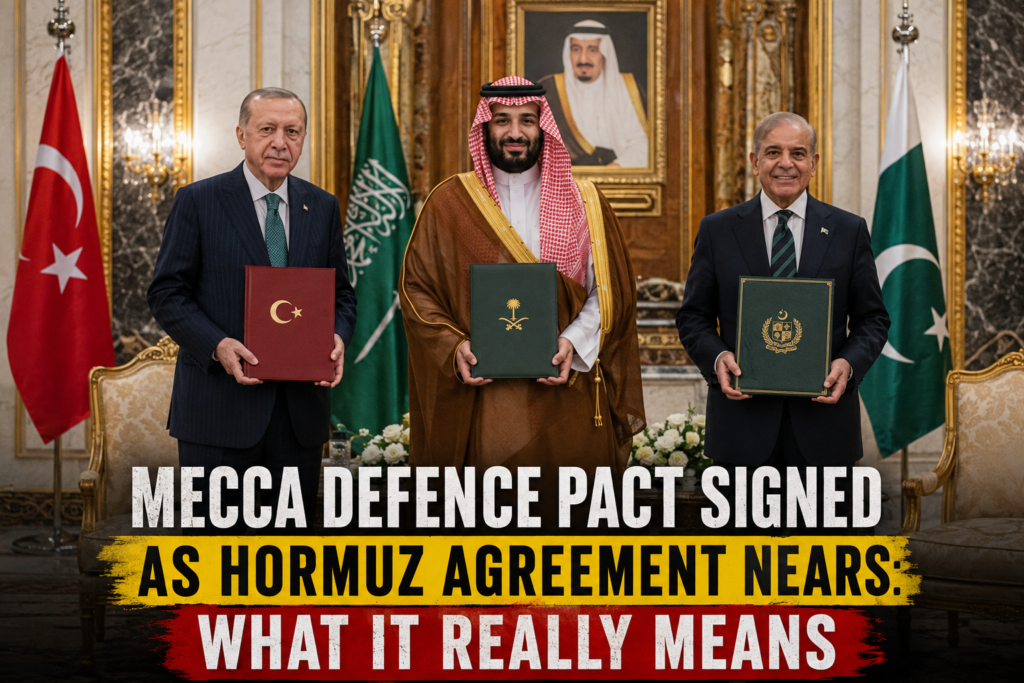
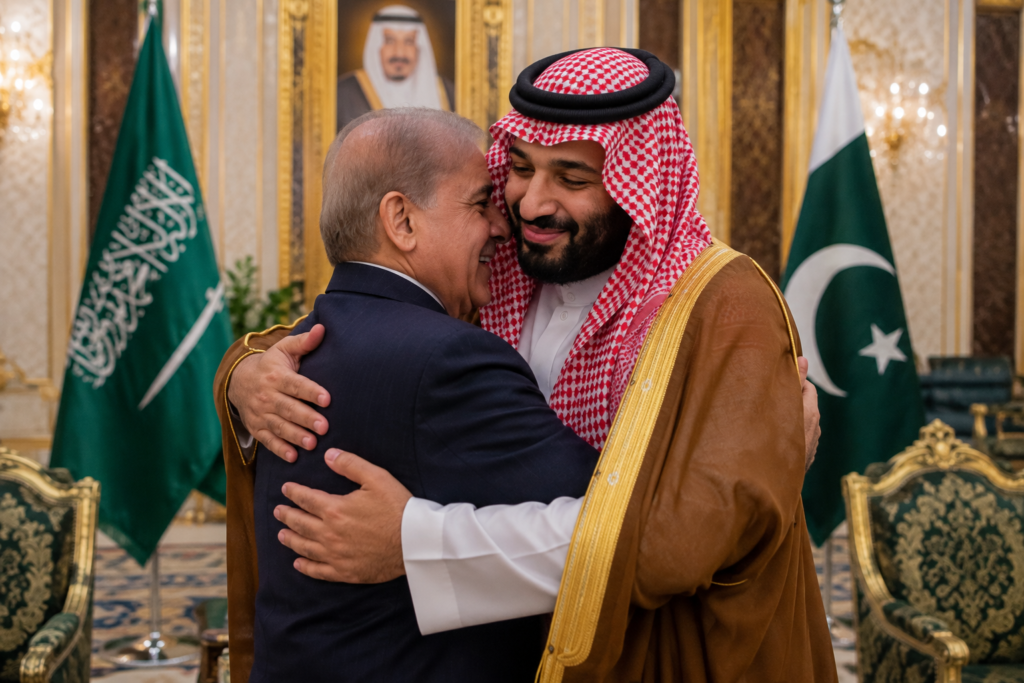
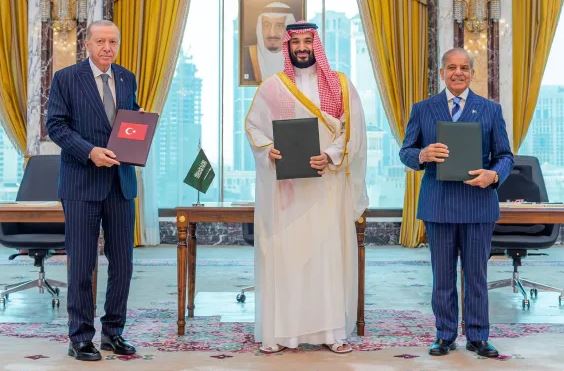
On Friday, three leaders put pen to paper: Saudi Crown Prince Mohammed bin Salman, Turkish President Recep Tayyip Erdoğan, and Pakistani Prime Minister Shehbaz Sharif. The treaty signed in Mecca therefore serves as a warning to Tehran: another major attack on Saudi Arabia could invoke the pact, draw Pakistan and Turkey into the conflict and dramatically widen the war.
The core line in the agreement is the part that matters most. It states that any armed attack against any one of the three states shall be regarded as an attack against them all. That’s the same “one for all” language NATO uses. It’s not subtle, and it’s not meant to be.
Saudi Arabia, Turkey and Pakistan have signed a mutual defense pact that would compel each country to intervene if another is attacked. Given that Pakistan is a nuclear-armed state, that detail alone has analysts talking.
Officials from all three countries were quick to insist this isn’t aimed at anyone in particular. A Turkish official said the pact is purely defensive in nature and pledges mutual support only for defence, adding it was not against any specific actor and remained open to other regional countries as well. Saudi Arabia went even further to shut down speculation about nuclear motives. Saudi Deputy Minister for Public Diplomacy Rayed Krimly said the pact is not linked to any nuclear ambitions, poses no threat to countries in the region, and does not represent an effort to establish a military axis or a sectarian bloc.
Read More : Sadiq Khan Biography and Political Career: From Bus Driver’s Son to Mayor of London
Worth noting: this isn’t a brand-new relationship being invented out of nowhere. Saudi Arabia and Pakistan already had a bilateral defence pact on the books. The Strategic Mutual Defence Agreement between Pakistan and Saudi Arabia was signed back in September 2025, committing both countries to treat an act of aggression against one as an act against both. The Mecca pact essentially widens that circle to include Turkey and formalizes it on a bigger stage.
Read More : Jimmy Burnham Biography: Family Facts About Andy Burnham’s Son
Why Now, of All Weeks
Timing tells you almost everything in geopolitics. This pact didn’t come out of a calm, quiet moment it landed in the middle of a genuinely dangerous stretch for Saudi Arabia. A Saudi official told CNN the kingdom was bracing for multiple coordinated attacks by Iran-backed Houthis and Iraqi militias, and that same day the Houthis launched a wave of attacks that reportedly killed and wounded dozens near the Yemen-Saudi border.
So this wasn’t a symbolic photo-op. It was three governments watching the region catch fire and deciding to make their alliance official before things got worse, not after.
Read More : Zohran Mamdani Biography: Age, Wife, Parents, Education, Political Career, and Net Worth
Meanwhile, the Hormuz Agreement Is Getting Close
Here’s the part that affects way more people than the defence pact does including anyone who fills up a gas tank or pays a heating bill. The Strait of Hormuz has been effectively shut since March, and that’s a huge deal because roughly a fifth of the planet’s oil and LNG normally moves through it.
For months, Iran and Oman have been quietly hammering out a technical fix. Iran announced it had agreed on the coordinates of new commercial shipping routes through the Strait of Hormuz with Oman after several rounds of negotiations. That sounds dry, but it’s actually the hardest part figuring out exactly which lanes ships can use without straying into contested waters.
The proposed setup is fairly clever. The deal would establish new shipping routes by allowing commercial vessels to enter the Persian Gulf through an Iranian-controlled route and exit through a route controlled by Oman. And crucially, any temporary routes would be without impediments meaning no approvals, no permissions, no tolls or charges, since the Strait of Hormuz is an international waterway that no single party controls.
But and this is the bit a lot of headlines are glossing over Iran isn’t treating this as a done deal that instantly reopens the strait. Iran’s Foreign Ministry spokesperson said the reopening of the strait is contingent on the US removing its naval blockade and halting all attacks on Iranian infrastructure, and that an understanding with Oman alone can’t guarantee the waterway is safe for passing vessels.
Diplomats close to the talks are being careful with their language too. Iran’s Deputy Foreign Minister said that while Iran and Oman are close to finalizing a proposed framework, the agreement would not automatically reopen the waterway, since Iran has additional demands of the United States.
Read More : Tiffany Trump Biography: Age, Husband, Parents, Education & Net Worth
What’s Actually on the Table
The negotiations go beyond just drawing lines on a map. Talks have covered technical arrangements, the security and sovereignty of Iran and Oman, and a proposed joint coordination center to manage maritime traffic and collect information from vessels, with temporary routes near Iran’s Larak Island set to close under the new arrangement.
The Numbers That Put This in Perspective
I like grounding a story like this in actual figures rather than just vibes, so here’s what the crisis has cost so far and what’s riding on a resolution.
| What | The Number | Why It Matters |
|---|---|---|
| Global oil/LNG shipped through Hormuz normally | About one-fifth of the world’s supply | Explains why prices spike globally the moment the strait wobbles |
| Duration of the current closure | Since late February/March 2026 | One of the longest disruptions to the strait in modern history |
| Merchant ships damaged since the crisis began | At least 17, with 7 reportedly abandoned | Shows this isn’t a distant risk — it’s an active shipping hazard |
| Seafarers killed or missing | 12 | The human cost behind the economic headlines |
| Vessels attacked (ADNOC alone, this week) | 15 since the conflict started, 3 this week | One crew member died and 20 were injured in ADNOC’s own vessels this week alone. |
| Strait width at its narrowest point | 21 miles | Explains why territorial-water claims by Iran and Oman make transit legally complicated |
Numbers like “12 seafarers killed” are easy to skim past in a headline, but that’s 12 people who went to work on a cargo ship and didn’t come home. It’s worth sitting with that for a second before we get back to the diplomacy.
How These Two Stories Connect
Here’s the thing that took me a minute to piece together, and I think it’s the actual story underneath the headlines: the Mecca Defence Pact and the Hormuz Agreement aren’t separate news items that happened to land the same week. They’re two sides of the same regional anxiety.
Saudi Arabia is locking in military backup because it doesn’t trust the current ceasefire dynamics to hold. Iran and Oman are working out a shipping fix because the economic pain of a closed strait has become unsustainable for everyone, including countries that aren’t even directly part of the conflict. One move is about deterrence. The other is about damage control. Both are reactions to the same underlying instability.
And there’s a direct link too the Hormuz talks are meant to help restore the ceasefire between Washington and Tehran, resolve the shipping disputes, and create room for broader negotiations on Iran’s nuclear programme. If that ceasefire framework wobbles again, the Mecca pact is exactly the kind of mechanism that could pull more countries into the fight.
What I’d Watch Next If I Were You
If you want to keep tabs on this without doom-scrolling all day, here’s my actual routine:
1. Watch for the official Hormuz text. Right now it’s a framework, not a signed agreement. The details on tolls, inspection rights, and US involvement will decide whether it actually calms shipping or just papers over the problem.
2. Track oil benchmark prices (Brent and WTI). They react to Hormuz news faster than any government statement does.
3. Watch how Iran responds to the Mecca pact. Turkey and Saudi officials keep saying it’s “not aimed at any country,” but Tehran gets the final say on how it reads that.
4. Follow shipping insurers and UKMTO advisories. War-risk insurance premiums for the Gulf are a quieter but honest signal of how safe the strait really is, regardless of what the diplomats say in public.
FAQs
What is the Mecca Defence Pact?
It’s a mutual defence agreement signed on Friday by Saudi Arabia, Turkey and Pakistan, stating that an armed attack on any one of the three counts as an attack on all three similar in spirit to NATO’s Article 5.
Does the Mecca Defence Pact target Iran?
Officials from all three signatory countries say no, describing it as purely defensive and open to other regional states. Whether that framing holds up depends a lot on how the region behaves in the coming weeks.
What is the Hormuz Agreement?
It’s the emerging framework between Iran and Oman to reopen the Strait of Hormuz to commercial shipping through newly agreed routes, after the strait was effectively closed since roughly the end of February 2026.
Is the Strait of Hormuz open right now?
Not fully. A route framework has reportedly been agreed between Iran and Oman, but Iran says the strait won’t be genuinely safe until the US naval blockade and strikes on Iranian infrastructure stop.
Why does the Strait of Hormuz matter to people outside the Middle East?
Because roughly one-fifth of the world’s oil and LNG passes through it. A prolonged closure pushes up fuel and energy costs pretty much everywhere, not just in the Gulf region.
Is Pakistan’s nuclear arsenal part of the Mecca pact?
Saudi officials have explicitly denied that the agreement has anything to do with nuclear ambitions, but the fact that Pakistan is a nuclear power has drawn extra attention to the pact regardless.
Conclusion
I’ll be honest stories like this are hard to wrap up neatly because nothing here is actually finished. The Mecca Defence Pact is signed, but its real test only comes if someone actually attacks Saudi Arabia or Turkey. The Hormuz Agreement is close, but “close” and “signed” aren’t the same thing, and Iran has made it clear there are strings attached.
What I do know is this: keep an eye on both stories together, not separately. The defence pact is the region preparing for the worst-case scenario. The Hormuz deal is the region trying to avoid it. Whichever one moves faster in the next few weeks will probably tell us a lot about where this whole conflict is headed.
This article reflects reporting current as of August 7, 2026. Given how fast this situation is moving, some details may shift by the time you’re reading this worth doing a quick news check before making any decisions based on it, especially anything tied to oil markets or travel.

C0-Founder and Editor
Tazeen and Arzoo are the Co-Founders and Editors of THE NEWSTER. They specialize in covering world news, technology, weather, business, and trending stories. Their mission is to deliver accurate, timely, and well-researched journalism while making complex topics clear, reliable, and easy for readers to understand.
About The Author