How to Use ChatGPT for Students to Study Smarter (2026 Guide)
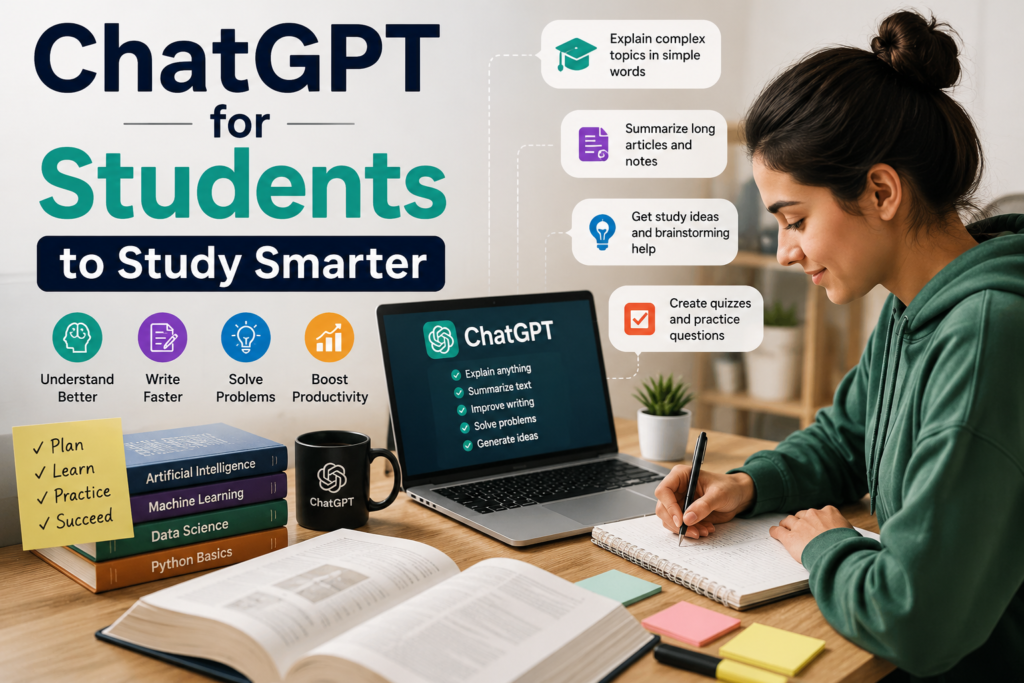
ChatGPT for Students to Study
Wondering how to use ChatGPT for students without just getting AI-written answers? Here’s the actual study system I built real steps, real mistakes, real stats.
How to Use ChatGPT for Students to Study Smarter (2026 Guide)
Three days before my statistics final, I had a color-coded planner, four textbooks open, and absolutely no idea what I actually needed to study. I’d been “studying” for two weeks and could not have told you a single confidence interval formula if you’d paid me.
That night I finally figured out how to use ChatGPT for students in a way that wasn’t just “ask it the answer and copy it down.” I fed it my messy lecture notes and asked it to build me a study plan for the next 72 hours, broken into blocks, ranked by what I was weakest on. I passed that exam with a grade I still don’t fully believe.
Since then I’ve refined that system a lot, mostly by getting it wrong in different ways first. This guide is what actually works, not the generic “just ask ChatGPT to help with homework” advice you see everywhere.
Why “Studying Smarter” and “Studying With AI” Aren’t the Same Thing
Here’s something I learned the hard way: using ChatGPT a lot doesn’t automatically mean you’re studying smarter. RAND’s research on student AI use found that while a large share of students use ChatGPT for schoolwork regularly, most of them say it “helps me finish faster” rather than “helps me learn better” only a small minority reported the tool actually improving how much they understood.
That gap matters. If you use ChatGPT for students’ most common purpose getting unstuck fast you’ll finish assignments quicker but might not retain much. If you use it for retrieval practice and structuring your study time instead, the outcomes look pretty different. A physics study out of Harvard found students paired with AI tutors learned significantly more in less time than students in standard active-learning classes, and Macquarie University reported a measurable bump in exam scores after integrating AI study tools into a course. The tool isn’t the variable how you use it is.
| Finding | Source |
|---|---|
| Only 23% of student ChatGPT users say it “helps me learn better”; 72% say it “helps me finish faster” | Student AI usage research (2026) |
| Harvard physics study found AI-tutored students learned more than double in less time vs. traditional classes | Harvard University (2025) |
| Macquarie University reported a 10% rise in exam results after AI tool integration | Macquarie University (2025) |
| AI-assisted students finish homework ~40% faster but score 10–15% lower on delayed retention tests | Classroom research data (2026) |
| Roughly 30% of students show signs of over-reliance on AI tools | Student behavior research (2026) |
That last row is the one that should make you pause. Speed and retention are pulling in opposite directions unless you’re deliberate about it.
Step 1: Use It to Diagnose What You Actually Don’t Know
Before you study anything, paste your notes or a practice test into ChatGPT and ask it to quiz you cold, no notes allowed. Whatever you get wrong is your real study list not whatever chapter feels scariest. I used to “study” my strongest subject the most because it felt productive. Turns out that’s just procrastination with extra steps.
Step 2: Turn Weak Spots Into a Real Schedule
Once you know your gaps, ask ChatGPT to build a time-blocked schedule around them something like “I have 6 hours over 3 days, I’m weakest on chapters 4 and 7, build me a plan.” It’s not magic, it’s just doing the planning math you’d normally avoid doing at 11 p.m.
Step 3: Use Active Recall, Not Passive Reading
This is the part people skip. Don’t ask ChatGPT to summarize a chapter and just read the summary that’s still passive. Instead, ask it to generate questions from the material and answer them yourself, closed-book. I pair this with Anki or Quizlet for spaced repetition once I’ve got a solid question set.
Step 4: Ask for Explanations in Multiple Formats
If something isn’t clicking, ask for it a different way: “explain this as an analogy,” then “explain this with a real-world example,” then “explain this like I’m teaching it to a 10-year-old.” I’ve had concepts finally land on the third version that never made sense on the first.
Step 5: Simulate the Actual Exam Format
If your professor uses multiple choice, ask ChatGPT to generate multiple choice questions in that style, not just open-ended ones. Matching the format of your practice to the format of your test makes a measurable difference it’s a big reason test-prep companies exist in the first place.
Step 6: Use It to Catch Your Own Blind Spots in Essays
After a first draft, I ask it to poke holes in my argument specifically, not just fix grammar. “What would someone who disagrees with this say?” is a genuinely useful prompt that pushes your thinking further instead of just polishing sentences.
Step 7: Set a Hard Stop on How Much You Lean On It
I now give myself a rule: if I’ve asked ChatGPT the same type of question three times in a row, I stop and go find a textbook explanation or ask my professor instead. That “30% of students show signs of dependency” stat from earlier isn’t abstract I’ve felt myself edging toward it during high-stress weeks, and the rule keeps me honest.
Real Example: My Study Week Before Finals
Here’s roughly what a week looked like once I got this system down:
– Monday: Diagnostic quiz from my own notes to find weak chapters
– Tuesday–Wednesday: Active recall sessions on the two weakest topics, spaced repetition in the evening
– Thursday: Practice exam in the actual question format my professor uses
– Friday: Review only what I got wrong on Thursday, nothing else
– Weekend: Light review, sleep prioritized over cramming
That structure did more for my grade than any single “trick” ever did.
Common Mistakes Students Make
– Treating ChatGPT like a search engine instead of a study tool. Asking it questions is only half the system the other half is testing yourself.
– Skipping the diagnostic step. Studying what’s comfortable instead of what’s weak is the single biggest time-waster I see.
– Not fact-checking factual claims. For anything with real stakes historical dates, scientific facts, citations verify independently before it ends up in an exam answer.
– Using it right before bed for genuinely new material. Some sleep and memory research suggests review works better earlier in the day when you can revisit it again before sleep.
– Ignoring your school’s specific rules. Some professors are fine with study aids but draw a hard line at graded work always check first.
Final Thoughts
If you take one thing from this, let it be this: learning how to use ChatGPT for students isn’t about getting answers faster. It’s about getting quizzed faster, which is a completely different skill. The night I stopped asking it to explain things to me and started asking it to test me instead was the night my grades actually started moving. It’s a small shift, but it’s the whole difference between studying and just feeling like you studied.
Read More : Best Gaming Mobile for PUBG – Top Phones for PUBG and COD Mobile in 2026

C0-Founder and Editor
Tazeen and Arzoo are the Co-Founders and Editors of THE NEWSTER. They specialize in covering world news, technology, weather, business, and trending stories. Their mission is to deliver accurate, timely, and well-researched journalism while making complex topics clear, reliable, and easy for readers to understand.
About The Author